
From Colleen’s Apothecary: April and the Quiet Wisdom of Violet Leaf
April always feels like a gentle invitation.
It is the month that reminds us not all growth announces itself loudly. Sometimes renewal begins in smaller ways: a little more light in the morning, the first tender green shoots, the soft return of birdsong, the subtle sense that something is shifting beneath the surface.
Nature never rushes this process, and neither should we.
There is something deeply comforting about April’s rhythm. The weather changes quickly, nourishing rains come and go, and the landscape responds in its own time. Storms pass, the sun returns, and life begins again in quiet, almost imperceptible ways. Even in regions where April signals cooling temperatures or the close of the wet season, the message remains the same: transformation is still happening.
This is why April is such a beautiful month to work with citrus, herbal, and green floral aromatics.
Sweet orange paired with lavender offers brightness softened by calm. Lemon with sage creates clarity and mental freshness. Grapefruit with marjoram brings lift with emotional steadiness. These combinations mirror the balance of the season itself: lightness with grounding, movement with patience.
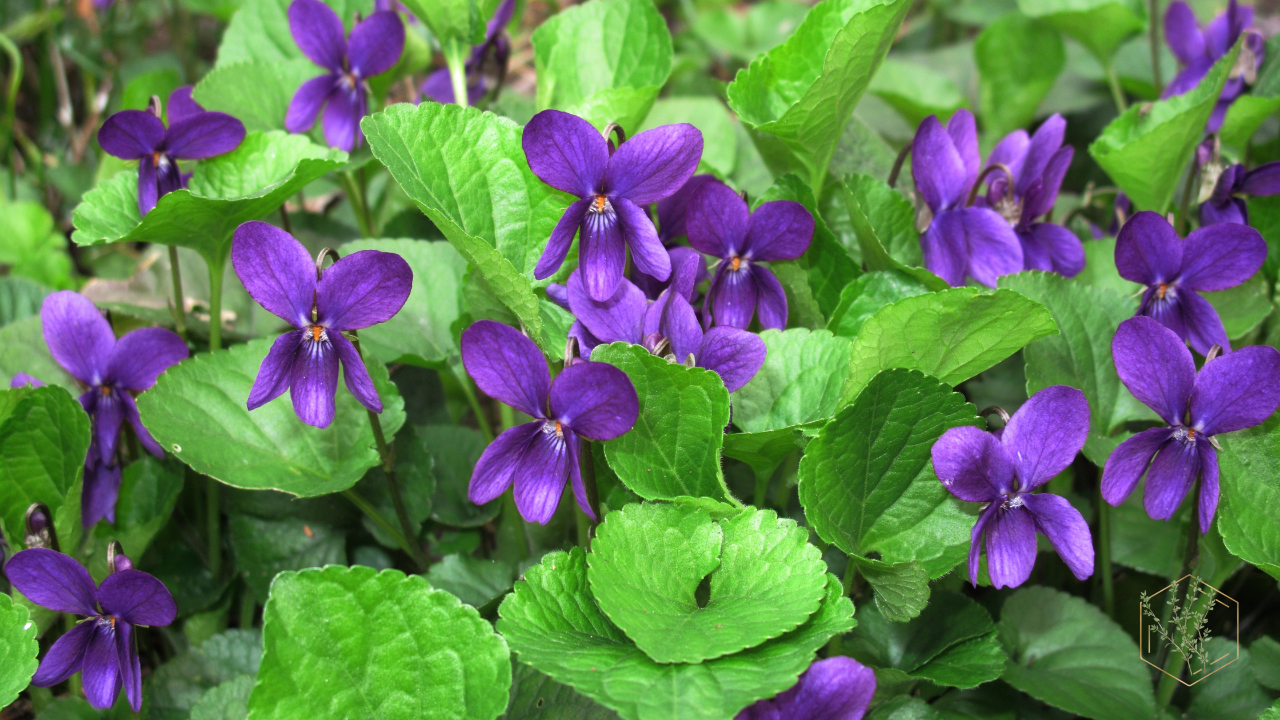
Yet if there is one aromatic that truly captures April for me, it is violet leaf absolute (Viola odorata).
Unlike the soft powdery floral note people often expect from the word violet, the leaf absolute is strikingly green. It smells like crushed leaves after rain, fresh stems, spring gardens, and damp earth warming under the sun. There is a delicate floral whisper beneath it, but what defines it most is that living green freshness.
This beautiful deep-green absolute is solvent extracted from the perennial violet plant, most commonly cultivated in France and Italy. It is one of those materials that immediately teaches students an important aromatic lesson: the plant always has more to reveal than we first assume.
Therapeutically, Viola odorata has long been appreciated for blends that support the respiratory system, nervous tension, skin applications, and fluid stagnation. Battaglia (2017) also notes its relevance for edema and the integumentary system, making it a fascinating material for students exploring aromatic nuance beyond the more commonly studied oils.
Recent research has added another layer of interest. Orchard et al. (2023) found noteworthy antimicrobial activity when violet leaf oil was paired with New Caledonian sandalwood (Santalum austrocaledonicum). What makes this especially relevant for serious students is the study’s emphasis on chemical variability among commercial samples and the importance of GCMS analysis.
This matters because violet leaf absolute is expensive, rare, and therefore highly susceptible to adulteration.
For students of aromatherapy and botanical medicine, this becomes a powerful reminder that learning an aroma is only one part of practice. True aromatic confidence also comes from understanding sourcing, extraction, constituent variation, and quality verification.
Most violet leaf absolute is still prized within natural perfumery, where its fresh leafy realism creates exquisite spring accords. A trace amount can completely transform a blend, giving it the sensation of life, freshness, and natural movement.
Perhaps that is why it feels so perfect for April.
It reminds us that growth often begins in the greenest, quietest places.
If this season is awakening your curiosity about the plants behind the oils, this is a beautiful time to deepen your botanical understanding through our Foundation of Herbalism, where the story of the plant always begins before the bottle.
Continue your botanical journey here with 25% off Kat Maier’s Foundation of Herbalism Course using the code FHMARCH26: www.essenceofthyme.com/foundation-of-herbalism
Or if you are willing to dive deep into the art and science of aromatherapy, explore our certification programs with $100 off until April 15, 2026 using code EOTSPRING 100: www.essenceofthyme.com/programs.
References:
Battaglia, S. The Complete Guide to Aromatherapy, Third Edition, Vol. 1 pp 591-592 (2017)
Orchard, A., Moosa, T., Motala, N., Kamatou, G., Viljoen, A., & Vuuren, S. V. (2023). Commercially available Viola odorata oil, chemical variability and antimicrobial activity. Molecules, 28(4), 1676, Open Access.

