
Creating an Aromatic Anchor That Stays
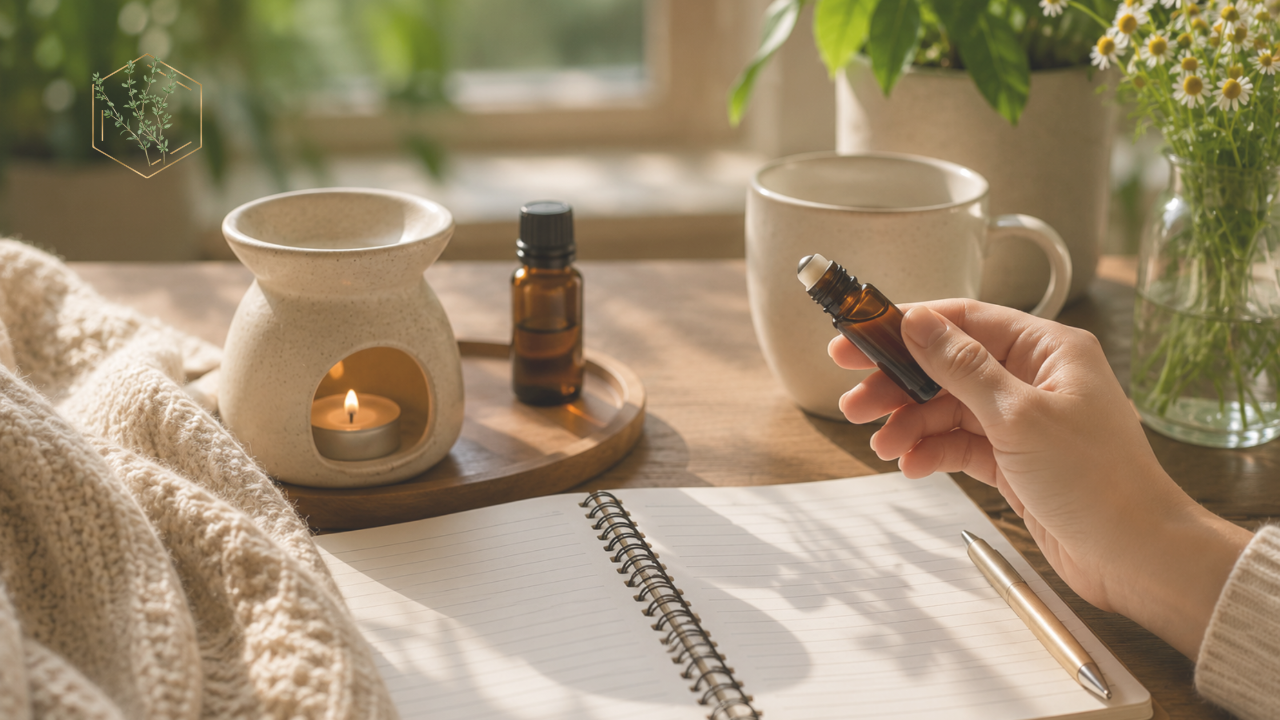
In July, we introduced aromatic anchoring as the deliberate pairing of one scent with one repeated practice. The idea is to let the aroma become a familiar cue for that moment. The useful part is the association learned through repetition and context.
Research shows that odours can act as memory cues, but the effects are not the same for every person or every type of memory. That makes consistency and observation important. It also means an aromatic anchor should be treated as a personal practice, not a guaranteed therapeutic result.
Keep the pairing clear
An aromatic anchor works best when the scent has one clear job.
You might reserve one inhaler for the three-minute centring practice you do before work. You might use one simple blend only when you begin a regular study session. The scent becomes part of a repeated context.
Problems begin when the same aroma appears during sleep, cleaning, work, meditation, and casual diffusing. It may still be pleasant, but it no longer points clearly to one practice.
What weakens an anchor
- Using the same scent for several purposes.
- Changing the blend or delivery method during the experiment.
- Using the scent only on difficult days instead of pairing it with a regular practice.
- Choosing a goal that is too broad, such as “feel better.”
- Expecting the aroma to create a strong emotional state on its own.
The oil may be safe and well chosen. The problem may simply be that the cue is inconsistent.
A two-week personal experiment
The following is a practical self-observation exercise. It is not a validated clinical protocol, and fourteen days is not a proven conditioning threshold.
An aromatic anchor asks two things to happen at once: the scent needs to become linked with the activity, and the activity itself needs to become familiar enough to hold that link.
Habit-formation research suggests that behaviours typically take anywhere from about three weeks to several months to start feeling automatic, with wide variation between people and activities (Lally et al., 2010). Two weeks is enough time to notice an early pattern, but not enough time for the pairing to feel automatic. That is exactly why this experiment asks you to observe a small shift rather than expect a strong one.
Before you begin
Choose one specific activity. Keep it short and repeatable. Examples include beginning a study session, settling into a brief breathing practice, or marking the end of the workday.
Choose one aroma that is pleasant or neutral to you, appropriate for the route, and safe for anyone who may be exposed. A personal inhaler is useful because it keeps the scent contained. Prepare enough for the full two weeks and do not change it.
Days 1 and 2
Complete the activity without the aroma. Before and after, rate one simple measure on a scale of 0 to 10. You might rate readiness to begin, mental activity, or ease of settling into the routine.
Days 3 to 14
Use the aroma immediately before the activity and keep it present briefly as the activity begins. Use the same amount, method, and general timing each day.
At the end of each day
Record the same rating and one sentence about what you noticed. Do not look for a dramatic response. You are watching for a small pattern, such as beginning with less resistance or recognizing the transition more quickly.
A simple somatic check
A somatic check is a brief observation of the body. It is not a diagnosis.
Before using the scent, notice your breathing, jaw, shoulders, hands, and the general speed of your thoughts. Use the aroma, pause for thirty seconds, then notice the same areas again.
Write one sentence. “My shoulders softened, but my mind still felt busy” is useful information. “No clear change, but I started the task more easily” is useful too.
The goal is to observe rather than convince yourself that the anchor worked.
When nothing happens
No noticeable change is still a result. Review the pairing before adding more oil or making the blend stronger. Was the scent reserved for one purpose? Was the activity clear? Was the routine repeated often enough to become familiar? Did you change the blend or timing?
You may decide to continue for another two weeks, adjust one part of the routine, or stop. Aromatic anchoring will not be useful for everyone, and one scent may not be the right cue for a particular person.
A practice becomes more trustworthy when it can include that conclusion.
Protect the meaning you built
If the aroma begins to feel linked with the practice, keep the pairing clean. Continue using it for the same purpose instead of turning it into an all-day background scent.
An aromatic anchor becomes more recognizable when the cue remains specific enough to be learned.
Continue your aromatherapy educationEssence of Thyme’s certification programs teach students to bring safety, context, observation, and individual response into the same decision. Explore the certification pathways at www.essenceofthyme.com/programs |
References
Herz, R. S. (2016). The role of odor-evoked memory in psychological and physiological health. Brain Sciences, 6(3), 22. https://doi.org/10.3390/brainsci6030022
Lally, P., van Jaarsveld, C.H.M., Potts, H.W.W. and Wardle, J. (2010), How are habits formed: Modelling habit formation in the real world†. Eur. J. Soc. Psychol., 40: 998-1009. https://doi.org/10.1002/ejsp.674 Psychology, 40(6), 998–1009.
Sorokowska, A., Nord, M., Stefańczyk, M. M., and Larsson, M. (2022). Odor-based context-dependent memory: Influence of olfactory cues on declarative and nondeclarative memory indices. Learning & Memory, 29(5), 136-141. https://doi.org/10.1101/lm.053562.121
Note: The two-week exercise is a practical self-observation activity, not a clinically tested protocol. Research supports the broader idea that scent can become linked with context and memory, but it does not show that a fourteen-day routine will create a reliable aromatic anchor.

