
Lavender: The Oil Everyone Assumes They Know
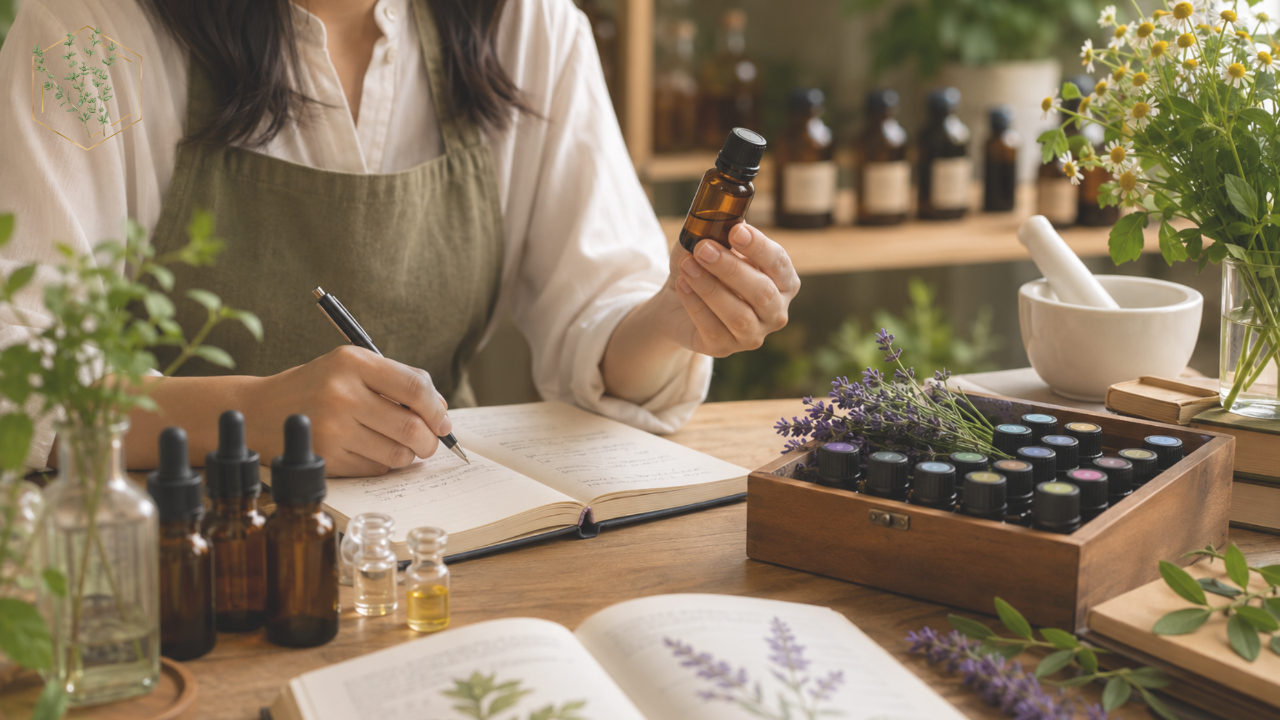
Lavender is often the first essential oil people buy. It appears in beginner kits, household products, bedtime routines, and formulas for skin and emotional support.
Because it is so familiar, it is easy to treat lavender as a single, predictable oil. The name feels complete even when the label tells us very little. Lavender is a useful example of why professional practice begins with identification rather than assumption.
Start with the botanical name.
True lavender is Lavandula angustifolia. Spike lavender is Lavandula latifolia. Lavandin is Lavandula x intermedia, a hybrid. They belong to the same genus, but they are different aromatic materials. A label that says only “lavender” does not tell you which one is inside the bottle.
This matters because species affects the chemical profile, aroma, safety considerations, and the role the oil may play in a formula. The botanical name provides the starting point.
Linalool and linalyl acetate are important, but they are not fixed.
Lavandula angustifolia is commonly rich in linalool and linalyl acetate. These two constituents help shape the aroma and are often the first numbers students look for on a GC/MS report.
The proportions can vary considerably. A 2021 study examined essential oils from thirteen Lavandula angustifolia cultivars. Linalool ranged from 11.4 to 46.7 percent, while linalyl acetate ranged from 7.4 to 44.2 percent. The researchers also found variation between growing years in several cultivars.
Those numbers do not mean that every authentic lavender oil will fit one narrow profile. They show why the species name alone is not the end of the assessment.
The plant and the distillation both matter.
Cultivar, climate, rainfall, temperature, flowering stage, and the growing year can influence the material produced by the plant.
Distillation can change what is collected as well. A study on Lavandula angustifolia found that distillation time affected both oil yield and the concentrations of several constituents. The authors concluded that distillation time should be considered when lavender oils are compared.
This is why two bottles of genuine Lavandula angustifolia may smell different or show different percentages on their reports. Essential oils are plant materials shaped by cultivation and production, so batches will not be identical.
What to check before using lavender as the default
- Is the complete botanical name on the bottle?
- Is the plant part and extraction method identified?
- Is the supplier clear about the growing region or source?
- Is a current, batch-specific GC/MS report available?
- Does the full profile make sense for the intended use and the person using it?
You do not need to turn every formula into a laboratory investigation. You need enough information to identify the lavender and explain why it belongs in the blend.
The familiar oil deserves careful study
Students tend to slow down with unfamiliar oils because they know there is more to learn. Familiar oils often escape that attention.
The next time you reach for lavender, pause before relying on what the common name has always meant to you. Read the botanical name. Review the batch report. Notice how the aroma compares with the last bottle you used. Ask what you know about this particular oil, not lavender in general.
Familiarity is a good beginning. Careful study makes it dependable.
Continue your aromatherapy education.
The Advanced Aromatherapy Science Program develops the research, plant biology, extraction, quality, and critical-thinking skills that support more precise aromatic practice. For Botanica 2026 attendees, you can use the code LAVANDULA10 for 10 percent off through August 31, 2026. Review the prerequisites and program details at www.essenceofthyme.com/advanced-aromatherapy-science
References
Pokajewicz, K., Białoń, M., Svydenko, L., Fedin, R., and Hudz, N. (2021). Chemical composition of the essential oil of the new cultivars of Lavandula angustifolia Mill. bred in Ukraine. Molecules, 26(18), 5681. https://doi.org/10.3390/molecules26185681
Zheljazkov, V. D., Cantrell, C. L., Astatkie, T., and Jeliazkova, E. (2013). Distillation time effect on lavender essential oil yield and composition. Journal of Oleo Science, 62(4), 195-199. https://doi.org/10.5650/jos.62.195

